Polynomial Loc-Scale-Regression#
Setup and Imports#
import jax
import jax.numpy as jnp
import liesel.goose as gs
import liesel.model as lsl
import numpy as np
import pandas as pd
import plotnine as p9
import tensorflow_probability.substrates.jax.distributions as tfd

import liesel_gam as gam
rng = np.random.default_rng(1)
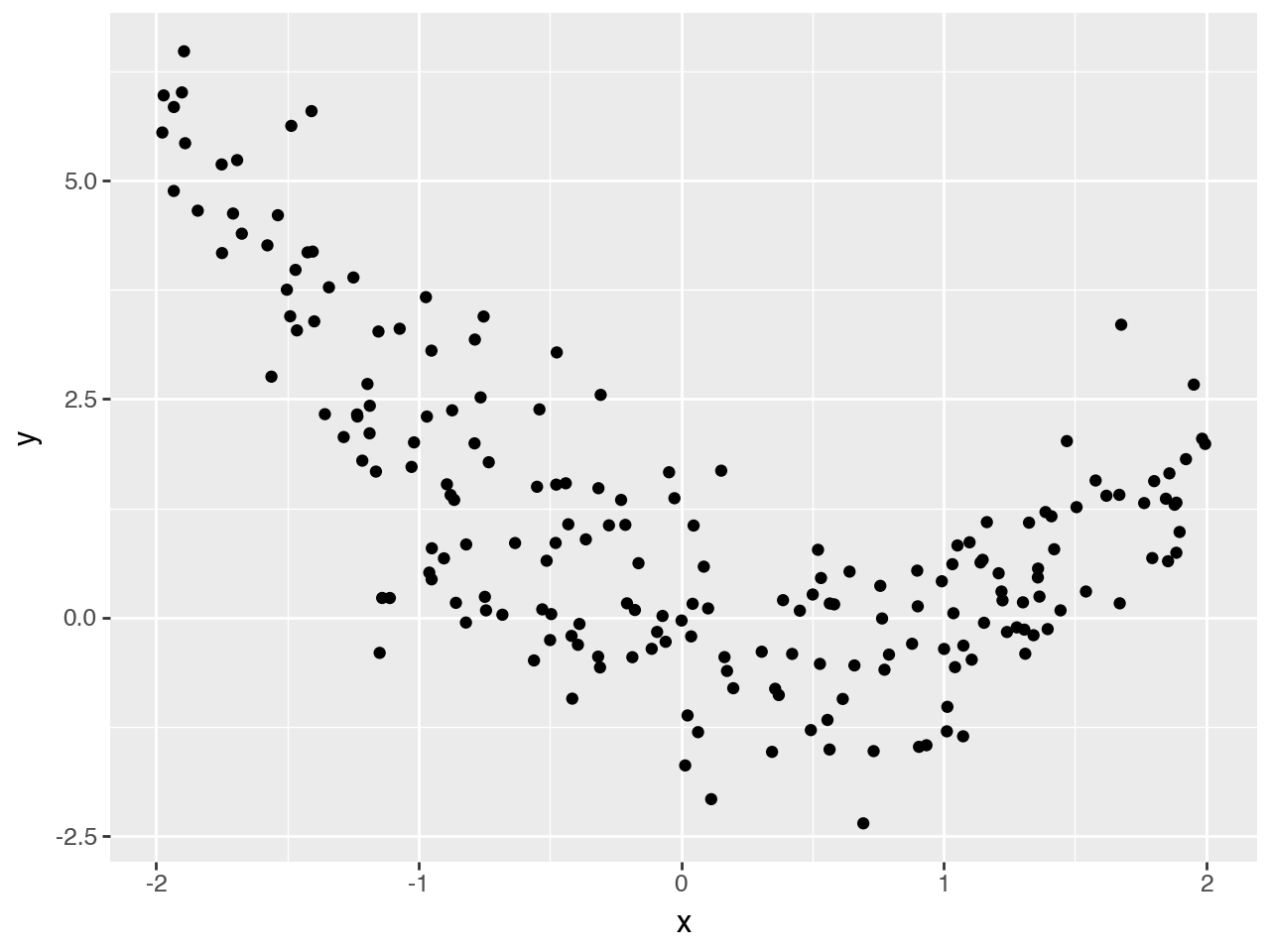
x = rng.uniform(-2, 2, 200)

log_sigma = -0.2 * x
mu = -x + x**2
y = mu + jnp.exp(log_sigma) * rng.normal(0.0, 1.0, 200)

df = pd.DataFrame({"y": y, "x": x})
(p9.ggplot(df) + p9.geom_point(p9.aes("x", "y")))
Model Definition#
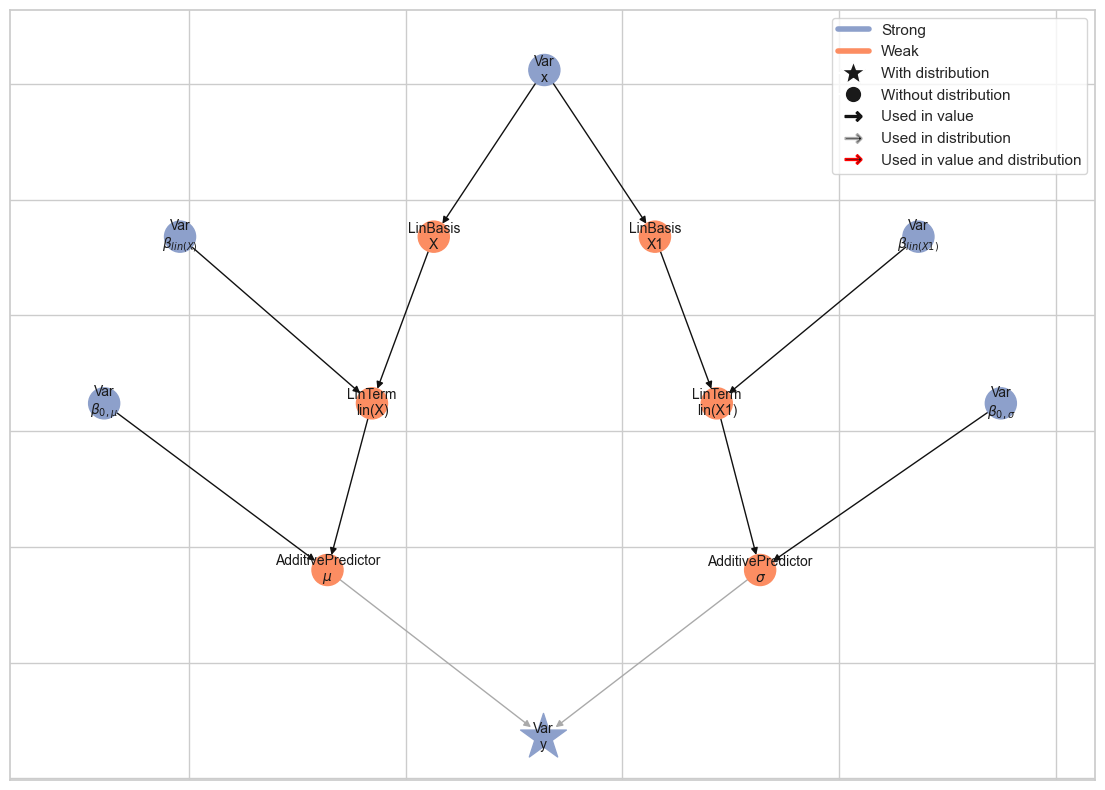
loc = gam.AdditivePredictor("$\\mu$")
scale = gam.AdditivePredictor("$\\sigma$", inv_link=jnp.exp)


y = lsl.Var.new_obs(
    value=df.y.to_numpy(),
    distribution=lsl.Dist(tfd.Normal, loc=loc, scale=scale),
    name="y",
)
tb = gam.TermBuilder.from_df(df)
loc += tb.lin("x + {x**2}")
scale += tb.lin("x")
Build and plot model#
model = lsl.Model([y])
model.plot_vars()
Run MCMC#
Since we used the inference arguments to specify MCMC kernels for all parameters above,
we can quickly set up the MCMC engine with gs.LieselMCMC (new in v0.4.0).
eb = gs.LieselMCMC(model).get_engine_builder(seed=1, num_chains=4)

eb.add_burnin(1000)
eb.add_posterior(10_000, thinning=10)

engine = eb.build()
engine.sample_all_epochs()
results = engine.get_results()
liesel.goose.builder - WARNING - No jitter functions provided for position keys '$\\beta_{0,\\sigma}$', '$\\beta_{lin(X1)}$', '$\\beta_{0,\\mu}$', '$\\beta_{lin(X)}$'. The initial values for these keys won't be jittered
liesel.goose.engine - INFO - Initializing kernels...
liesel.goose.engine - INFO - Done
liesel.goose.engine - INFO - Starting epoch: BURNIN, 1000 transitions, 1000 jitted together
100%|██████████████████████████████████████████| 1/1 [00:03<00:00,  3.22s/chunk]
liesel.goose.engine - INFO - Finished epoch
liesel.goose.engine - INFO - Finished warmup
liesel.goose.engine - INFO - Starting epoch: POSTERIOR, 10000 transitions, 1000 jitted together
100%|████████████████████████████████████████| 10/10 [00:01<00:00,  9.27chunk/s]
liesel.goose.engine - INFO - Finished epoch
MCMC summary#
summary = gs.Summary(results)
summary
Parameter summary:
| kernel | mean | sd | q_0.05 | q_0.5 | q_0.95 | sample_size | ess_bulk | ess_tail | rhat | ||
|---|---|---|---|---|---|---|---|---|---|---|---|
| parameter | index | ||||||||||
| $\beta_{0,\mu}$ | () | kernel_02 | -0.120440 | 0.094327 | -0.278698 | -0.121568 | 0.034348 | 4000 | 2880.892280 | 3405.121153 | 1.000439 |
| $\beta_{0,\sigma}$ | () | kernel_00 | -0.101203 | 0.051107 | -0.184955 | -0.101575 | -0.015275 | 4000 | 3836.126101 | 3838.462468 | 0.999941 |
| $\beta_{lin(X)}$ | (0,) | kernel_03 | -1.026619 | 0.060915 | -1.126641 | -1.027187 | -0.926506 | 4000 | 3783.204421 | 3641.794017 | 0.999428 |
| (1,) | kernel_03 | 1.033473 | 0.056802 | 0.942452 | 1.033228 | 1.129125 | 4000 | 2829.652664 | 3701.969987 | 1.000731 | |
| $\beta_{lin(X1)}$ | (0,) | kernel_01 | -0.140698 | 0.050012 | -0.222453 | -0.140182 | -0.056971 | 4000 | 4095.049144 | 3817.189105 | 1.001336 |
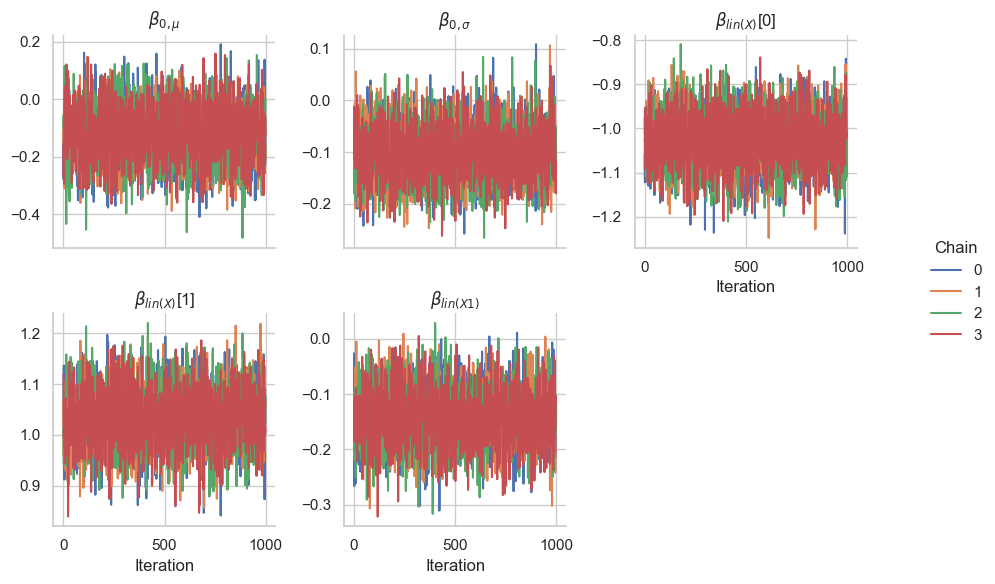
MCMC trace plots#
gs.plot_trace(results)
<seaborn.axisgrid.FacetGrid at 0x13dd2f610>
Predictions#
samples = results.get_posterior_samples()
Predict variables at new x values#
x_grid = jnp.linspace(x.min(), x.max(), 300)
predictions = model.predict(
    samples=samples,
    predict=["lin(X)", "lin(X1)", "$\\mu$", "$\\sigma$"],
    newdata={"x": x_grid},
)

predictions_summary = gs.SamplesSummary(predictions).to_dataframe().reset_index()
predictions_summary["x"] = np.tile(x_grid, len(predictions))
predictions_summary.head()
| variable | var_fqn | var_index | sample_size | mean | var | sd | ess_bulk | ess_tail | mcse_mean | mcse_sd | rhat | q_0.05 | q_0.5 | q_0.95 | hdi_low | hdi_high | x | |
|---|---|---|---|---|---|---|---|---|---|---|---|---|---|---|---|---|---|---|
| 0 | $\mu$ | $\mu$[0] | (0,) | 4000 | 5.947023 | 0.059801 | 0.244543 | 3230.505662 | 3651.905009 | 0.004305 | 0.002774 | 0.999674 | 5.534438 | 5.949018 | 6.350981 | 5.569644 | 6.370417 | -1.976702 |
| 1 | $\mu$ | $\mu$[1] | (1,) | 4000 | 5.879270 | 0.058344 | 0.241546 | 3239.614025 | 3651.586267 | 0.004247 | 0.002739 | 0.999643 | 5.471073 | 5.881016 | 6.278395 | 5.511409 | 6.302707 | -1.963415 |
| 2 | $\mu$ | $\mu$[2] | (2,) | 4000 | 5.811897 | 0.056917 | 0.238573 | 3245.814362 | 3687.244032 | 0.004190 | 0.002705 | 0.999632 | 5.408678 | 5.813008 | 6.206538 | 5.448952 | 6.231711 | -1.950128 |
| 3 | $\mu$ | $\mu$[3] | (3,) | 4000 | 5.744873 | 0.055519 | 0.235625 | 3252.757797 | 3687.244032 | 0.004133 | 0.002671 | 0.999623 | 5.346520 | 5.745001 | 6.134404 | 5.382929 | 6.156501 | -1.936841 |
| 4 | $\mu$ | $\mu$[4] | (4,) | 4000 | 5.678220 | 0.054150 | 0.232702 | 3261.208882 | 3651.458166 | 0.004076 | 0.002637 | 0.999619 | 5.284647 | 5.678637 | 6.062679 | 5.323129 | 6.088024 | -1.923554 |
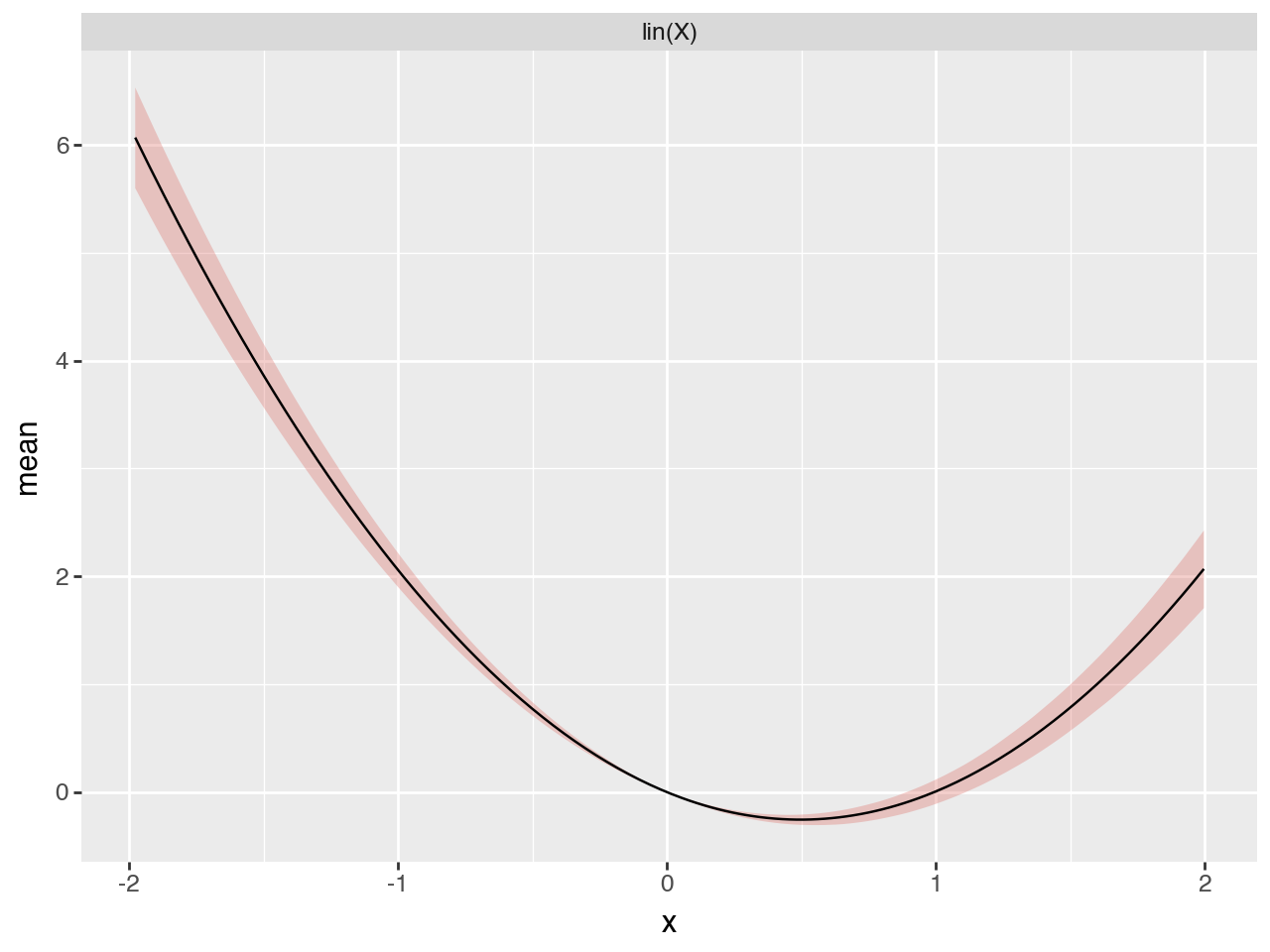
Plot fitted functions#
select = predictions_summary["variable"].isin(["lin(X)", "lin(X2)"])
(
    p9.ggplot(predictions_summary[select])
    + p9.geom_ribbon(
        p9.aes("x", ymin="q_0.05", ymax="q_0.95", fill="variable"), alpha=0.3
    )
    + p9.geom_line(p9.aes("x", "mean"))
    + p9.facet_wrap("~variable", scales="free_y", ncol=1)
    + p9.guides(fill="none")
)
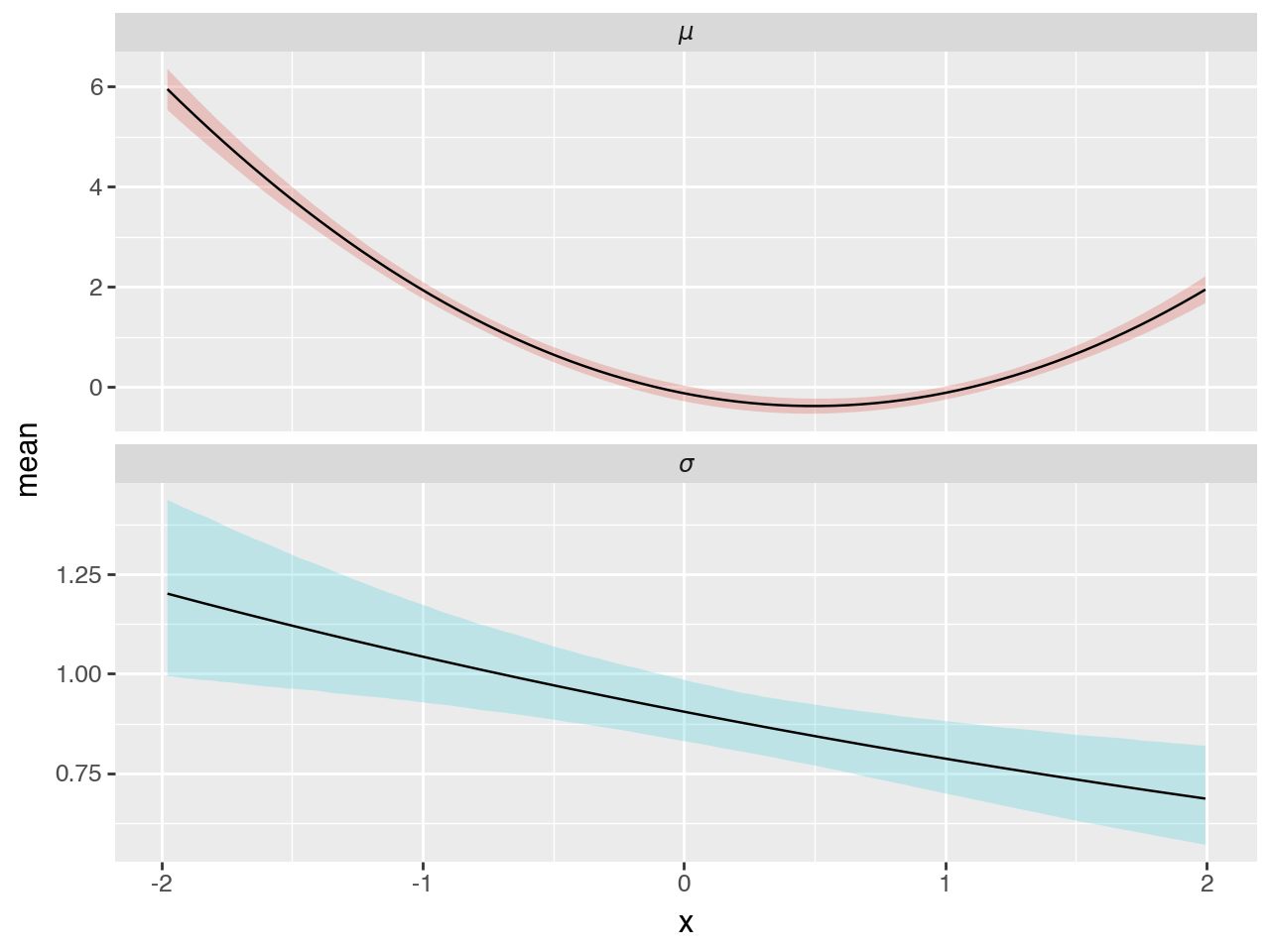
Plot parameters as functions of covariate#
select = predictions_summary["variable"].isin(["$\\mu$", "$\\sigma$"])
(
    p9.ggplot(predictions_summary[select])
    + p9.geom_ribbon(
        p9.aes("x", ymin="q_0.05", ymax="q_0.95", fill="variable"), alpha=0.3
    )
    + p9.geom_line(p9.aes("x", "mean"))
    + p9.facet_wrap("~variable", scales="free_y", ncol=1)
    + p9.guides(fill="none")
)
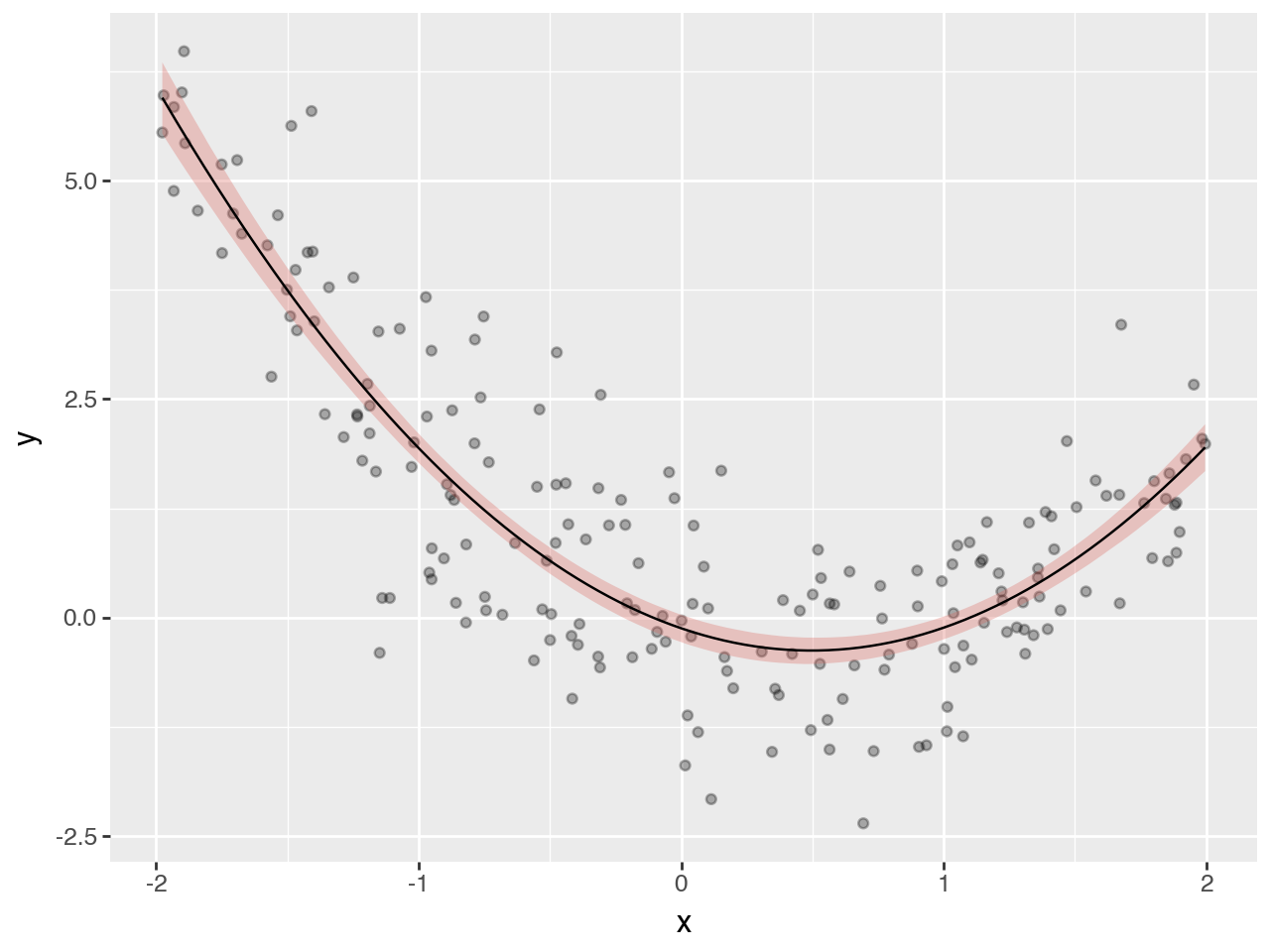
Plot mean function with data#
select = predictions_summary["variable"].isin(["$\\mu$"])
(
    p9.ggplot(predictions_summary[select])
    + p9.geom_point(p9.aes("x", "y"), data=df, alpha=0.3)
    + p9.geom_ribbon(
        p9.aes("x", ymin="q_0.05", ymax="q_0.95", fill="variable"), alpha=0.3
    )
    + p9.geom_line(p9.aes("x", "mean"))
    + p9.guides(fill="none")
)
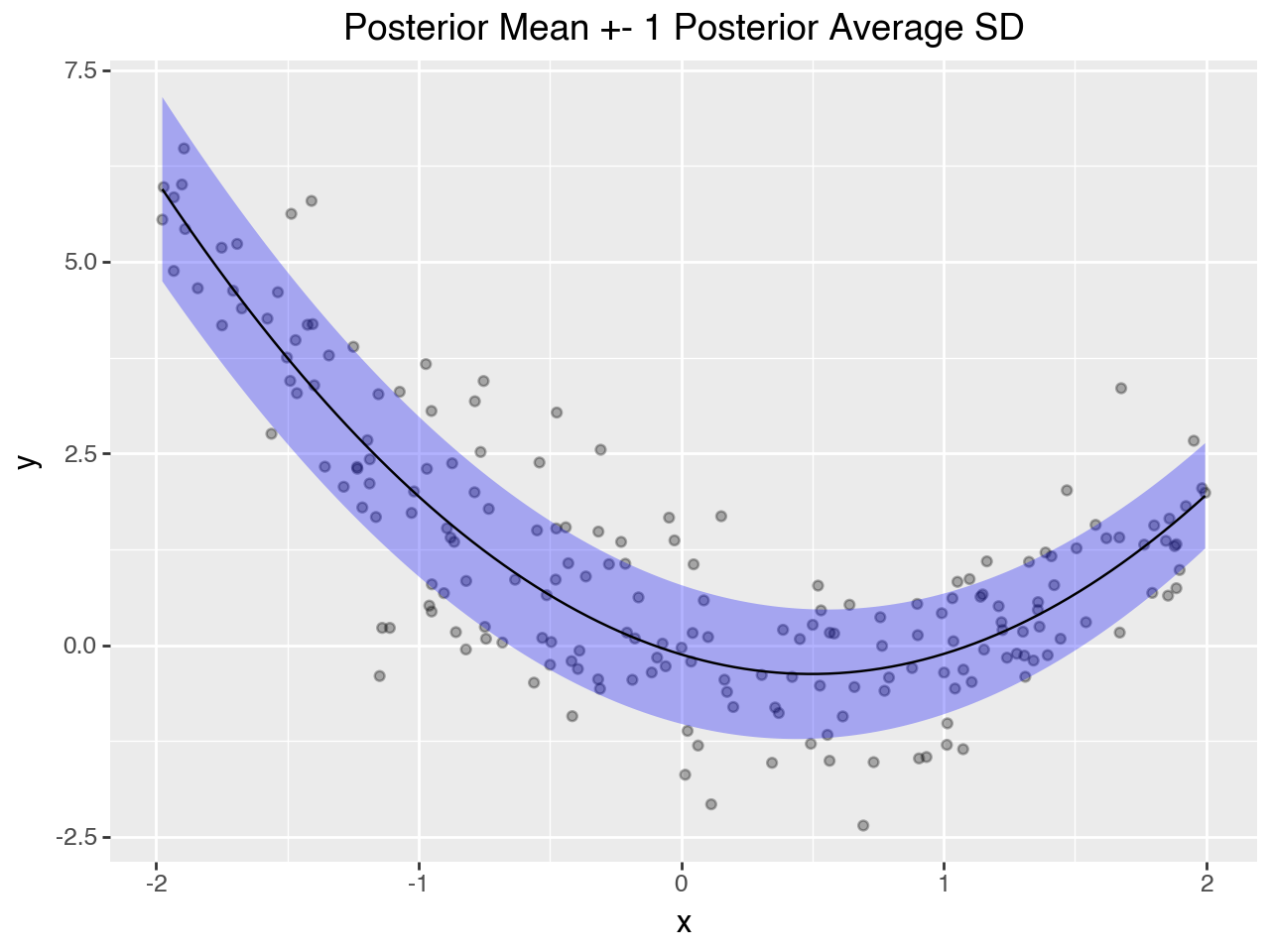
Plot average posterior predictive distribution#
select = predictions_summary["variable"].isin(["$\\mu$", "$\\sigma$"])
mu_sigma_df = (
    predictions_summary[select][["variable", "mean", "x"]]
    .pivot(index="x", columns=["variable"], values="mean")
    .reset_index()
)

mu_sigma_df["low"] = mu_sigma_df["$\\mu$"] - mu_sigma_df["$\\sigma$"]
mu_sigma_df["high"] = mu_sigma_df["$\\mu$"] + mu_sigma_df["$\\sigma$"]
mu_sigma_df
| variable | x | $\mu$ | $\sigma$ | low | high |
|---|---|---|---|---|---|
| 0 | -1.976702 | 5.947023 | 1.201194 | 4.745830 | 7.148217 |
| 1 | -1.963415 | 5.879270 | 1.198869 | 4.680401 | 7.078139 |
| 2 | -1.950128 | 5.811897 | 1.196550 | 4.615346 | 7.008447 |
| 3 | -1.936841 | 5.744873 | 1.194239 | 4.550634 | 6.939112 |
| 4 | -1.923554 | 5.678220 | 1.191927 | 4.486293 | 6.870147 |
| ... | ... | ... | ... | ... | ... |
| 295 | 1.942956 | 1.786320 | 0.691626 | 1.094695 | 2.477946 |
| 296 | 1.956243 | 1.826223 | 0.690378 | 1.135845 | 2.516601 |
| 297 | 1.969530 | 1.866492 | 0.689135 | 1.177358 | 2.555627 |
| 298 | 1.982817 | 1.907126 | 0.687889 | 1.219238 | 2.595015 |
| 299 | 1.996104 | 1.948120 | 0.686650 | 1.261469 | 2.634770 |
300 rows × 5 columns
(
    p9.ggplot()
    + p9.geom_point(p9.aes("x", "y"), data=df, alpha=0.3)
    + p9.geom_ribbon(
        p9.aes("x", ymin="low", ymax="high"),
        alpha=0.3,
        fill="blue",
        data=mu_sigma_df,
    )
    + p9.geom_line(p9.aes("x", "$\\mu$"), data=mu_sigma_df)
    + p9.labs(title="Posterior Mean +- 1 Posterior Average SD")
    + p9.guides(fill="none")
)
Posterior Predictive Checks#
Draw posterior predictive samples#
ppsamples = model.sample(shape=(3,), seed=jax.random.key(1), posterior_samples=samples)

ppsamples["y"].shape
(3, 4, 1000, 200)
# can be reshaped to concatenate the first two axes
_ = ppsamples["y"].reshape(-1, *ppsamples["y"].shape[2:])
Summarize posterior predictive samples#
ppsamples = model.sample(
    shape=(),  # just draw 1 value for each posterior sample
    seed=jax.random.key(1),
    posterior_samples=samples,
)

# summarise ppsamples
ppsamples_summary = gs.SamplesSummary(ppsamples).to_dataframe().reset_index()

# add covariate to df
ppsamples_summary["x"] = df["x"].to_numpy()
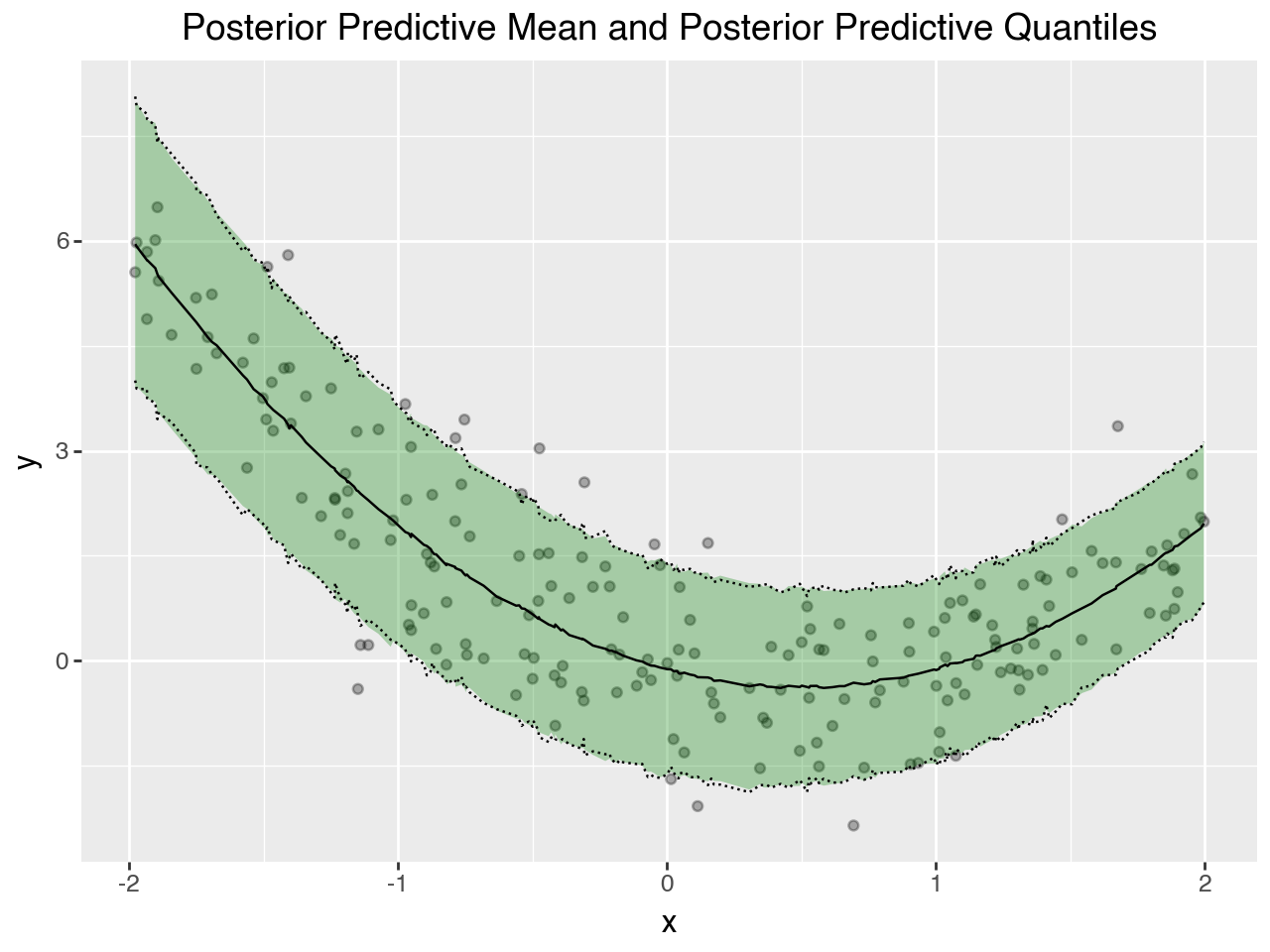
Plot posterior predictive summary#
(
    p9.ggplot(ppsamples_summary)
    + p9.geom_point(p9.aes("x", "y"), data=df, alpha=0.3)
    + p9.geom_ribbon(
        p9.aes("x", ymin="q_0.05", ymax="q_0.95"),
        alpha=0.3,
        fill="green",
    )
    + p9.geom_line(p9.aes("x", "hdi_low"), linetype="dotted")
    + p9.geom_line(p9.aes("x", "hdi_high"), linetype="dotted")
    + p9.geom_line(p9.aes("x", "mean"))
    + p9.labs(title="Posterior Predictive Mean and Posterior Predictive Quantiles")
    + p9.guides(fill="none")
)
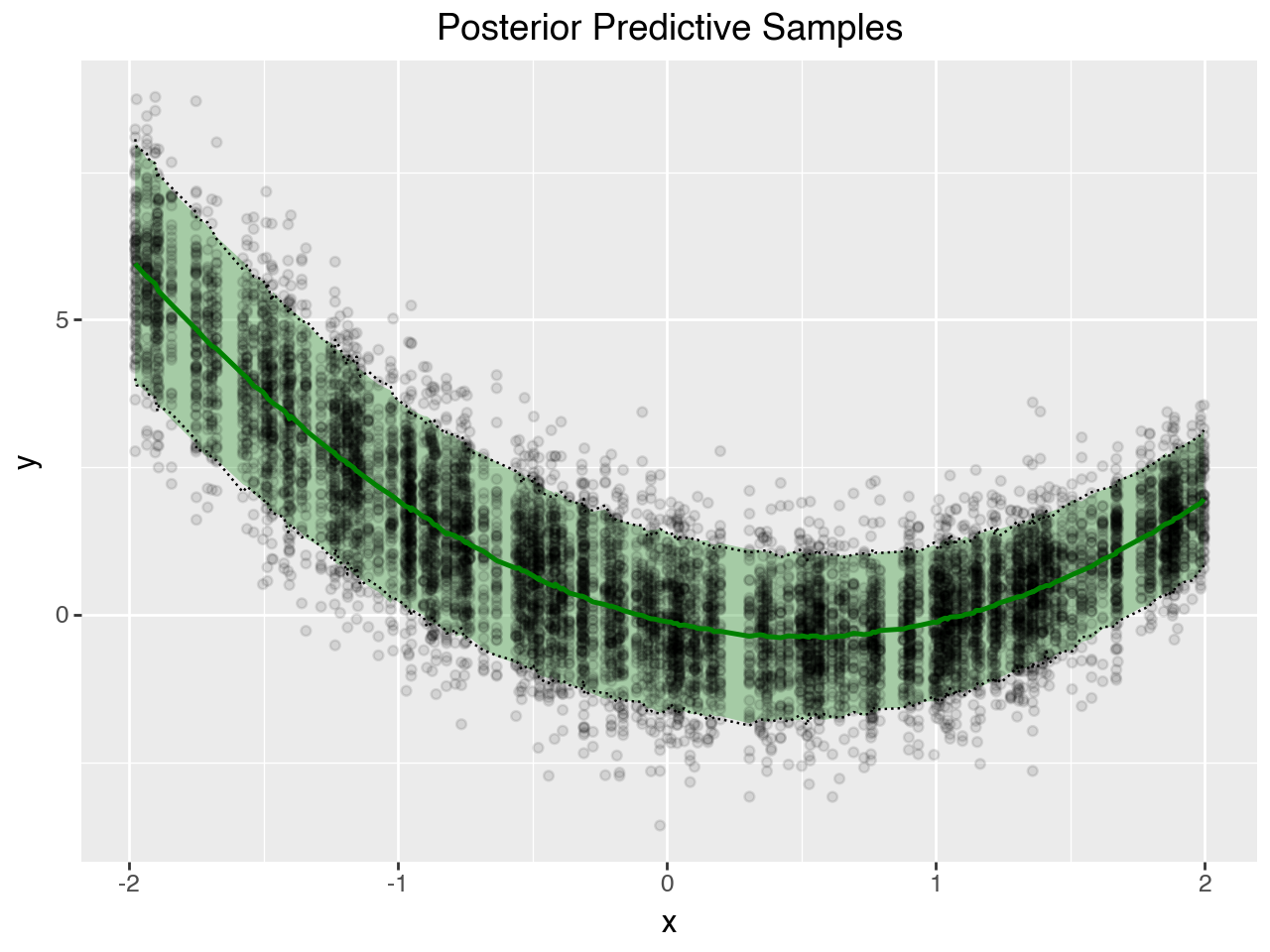
Plot posterior predictive samples#
ppsamples_reshaped = ppsamples["y"].reshape(-1, *ppsamples["y"].shape[2:])
ppsamples_df = pd.DataFrame(ppsamples_reshaped.T)
ppsamples_df["x"] = df["x"].to_numpy()
ppsamples_df = ppsamples_df.melt(id_vars=["x"], value_name="y", var_name="sample")
ppsamples_df[ppsamples_df["sample"].isin(range(5))]


nsamples = 50


(
    p9.ggplot(ppsamples_df[ppsamples_df["sample"].isin(range(nsamples))])
    + p9.labs(title="Posterior Predictive Samples")
    + p9.geom_ribbon(
        p9.aes("x", ymin="q_0.05", ymax="q_0.95"),
        alpha=0.3,
        fill="green",
        data=ppsamples_summary,
    )
    + p9.geom_point(p9.aes("x", "y"), alpha=0.1)
    + p9.geom_line(p9.aes("x", "hdi_low"), linetype="dotted", data=ppsamples_summary)
    + p9.geom_line(p9.aes("x", "hdi_high"), linetype="dotted", data=ppsamples_summary)
    + p9.geom_line(p9.aes("x", "mean"), color="green", size=1, data=ppsamples_summary)
)