TX: Tensor Product Interaction with pre-optimization#
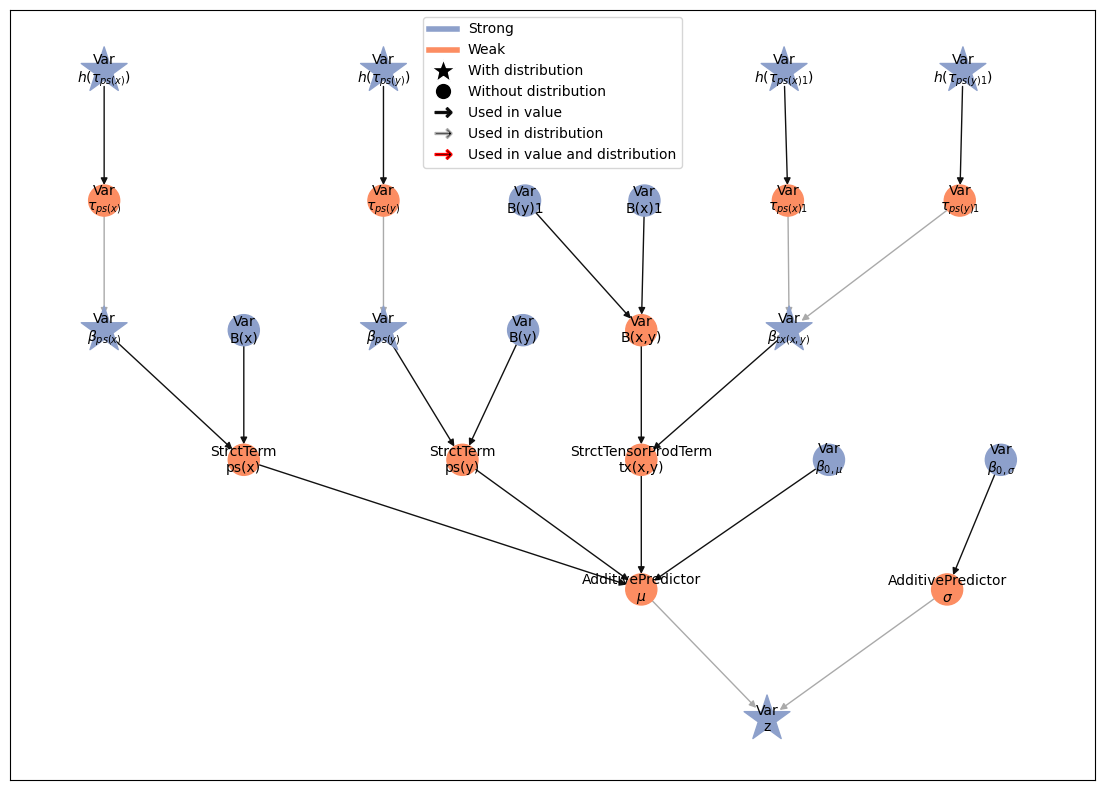
This notebook shows an exmaple of how to use liesel_gam.consolidate_bases to turn weak basis matrix variables into strong ones - this can be necessary to avoid problems with callbacks to R, especially when trying to optimize for good starting values using liesel.goose.optim_flat.
Setup and Imports#
import jax.numpy as jnp
import liesel.goose as gs
import liesel.model as lsl
import matplotlib.pyplot as plt
import numpy as np
import plotnine as p9
import tensorflow_probability.substrates.jax.distributions as tfd

import liesel_gam as gam
from liesel_gam.consolidate_bases import consolidate_bases, evaluate_bases
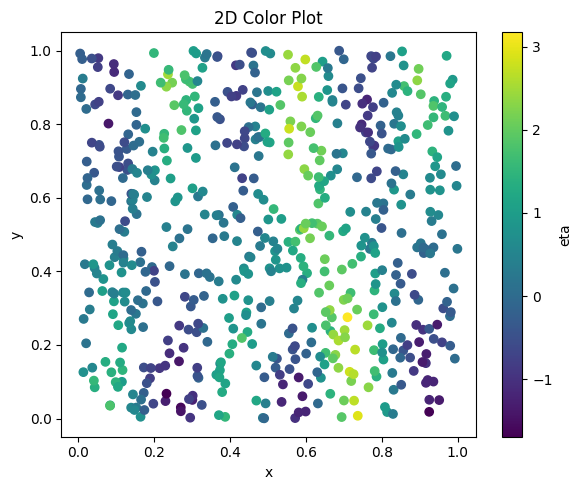
df = gam.demo_data_ta(n=600, noise_sd=0.25, seed=42)
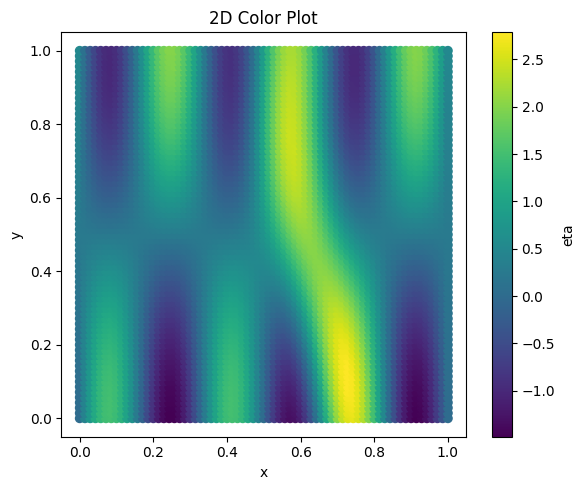
df_grid = gam.demo_data_ta(n=5000, grid=True)
plt.figure(figsize=(6, 5))
plt.scatter(df["x"], df["y"], c=df["z"])
plt.xlabel("x")
plt.ylabel("y")
plt.title("2D Color Plot")
plt.colorbar(label="eta")
plt.tight_layout()
plt.show()
plt.figure(figsize=(6, 5))
plt.scatter(df_grid["x"], df_grid["y"], c=df_grid["eta"])
plt.xlabel("x")
plt.ylabel("y")
plt.title("2D Color Plot")
plt.colorbar(label="eta")
plt.tight_layout()
plt.show()
Model Definition#
Setup response model#
loc = gam.AdditivePredictor("$\\mu$")
scale = gam.AdditivePredictor("$\\sigma$", inv_link=jnp.exp)


z = lsl.Var.new_obs(
    value=df.z.to_numpy(),
    distribution=lsl.Dist(tfd.Normal, loc=loc, scale=scale),
    name="z",
)
import tensorflow_probability.substrates.jax.bijectors as tfb


def scale_fn():
    prior = lsl.Dist(
        tfd.HalfNormal,
        scale=jnp.array(20.0),
    )

    scale = lsl.Var.new_param(
        jnp.array(0.1),
        distribution=prior,
        name="{x}",  # {x} is a placeholder for the automatically generated name
    )

    scale.transform(
        tfb.Softplus(),
        inference=gs.MCMCSpec(gs.IWLSKernel.untuned),
        name="h({x})",  # {x} is a placeholder for the automatically generated name
    )
    return scale


tb = gam.TermBuilder.from_df(df, default_scale_fn=scale_fn)
loc += (
    tb.ps("x", k=20),
    tb.ps("y", k=20),
    tb.tx(
        tb.ps("x", k=10),
        tb.ps("y", k=10),
    ),
)
Build and plot model#
model = lsl.Model([z])
model.plot_vars()
liesel.model.model - INFO - Converted dtype of Value(name="z_value").value
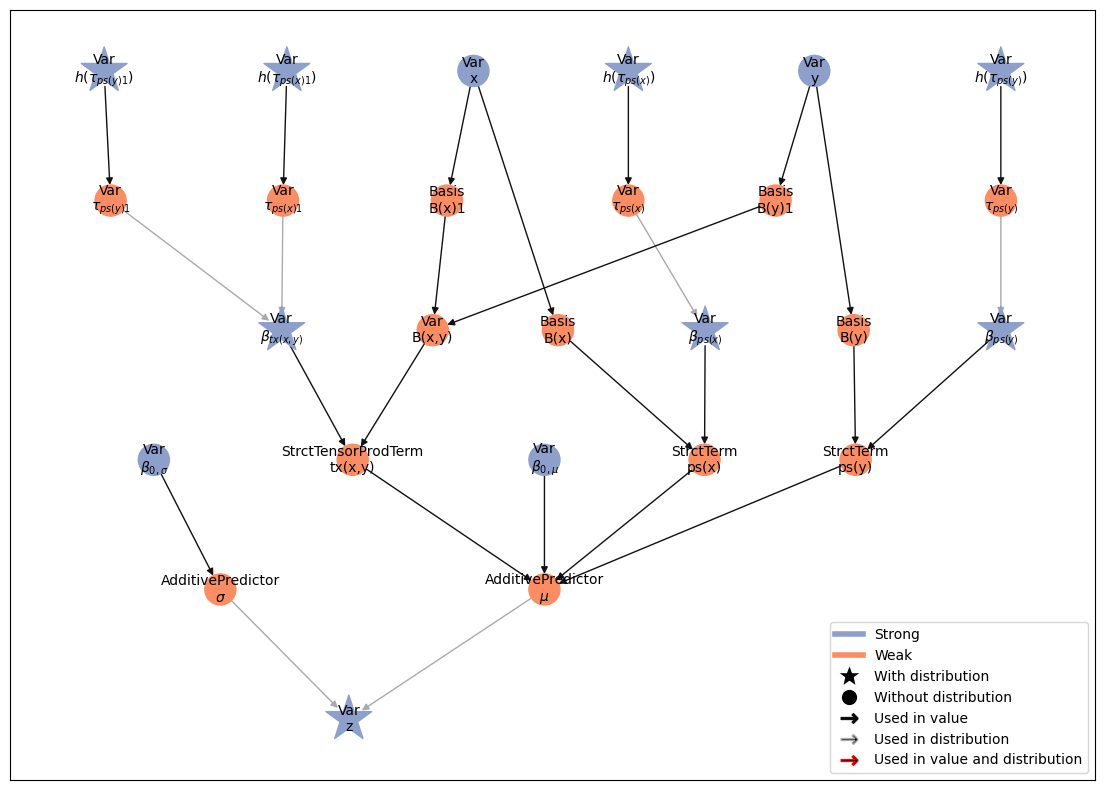
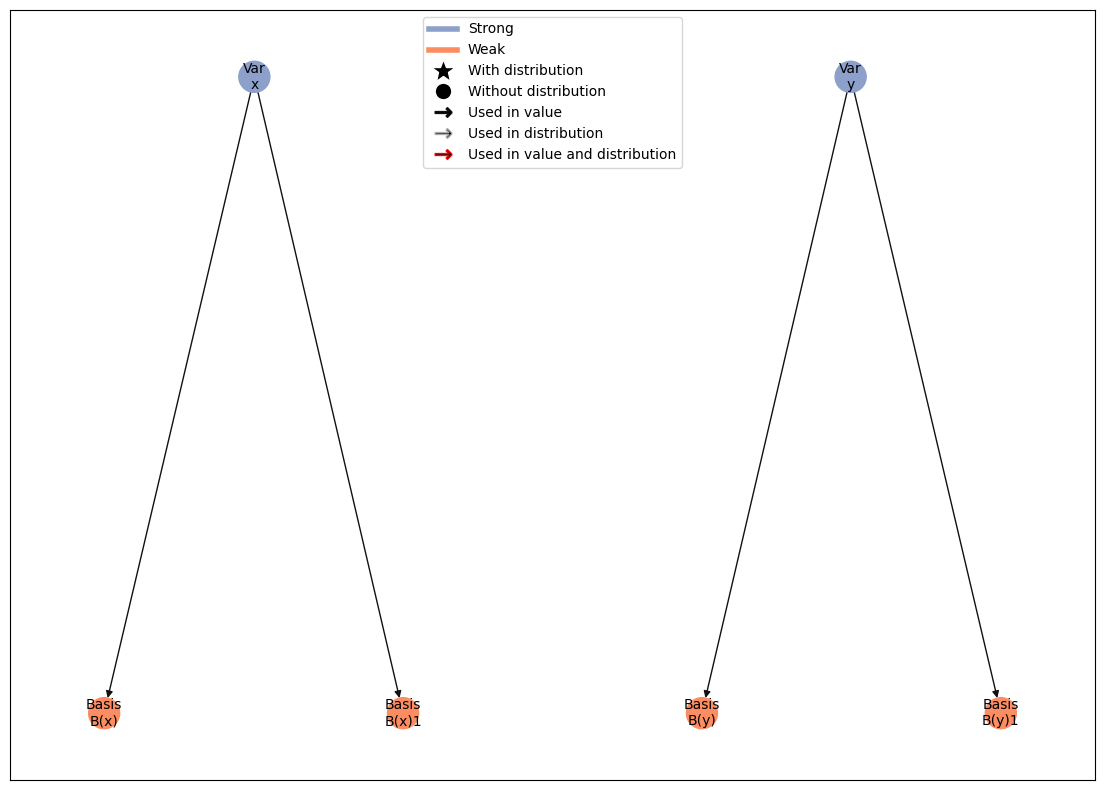
model, bases_model = consolidate_bases(model)
bases_model.plot_vars()
model.plot_vars()
import optax

params = [p.name for p in model.parameters.values() if not p.name.startswith("$\\tau")]

# this is the optimization
# I am being lazy here: Usually, convergence should be assessed.
opt = gs.optim_flat(
    model,
    params,
    optimizer=optax.adam(learning_rate=1e-3),
    progress_bar=False,
)

model.state = model.update_state(opt.position)
Run MCMC#
eb = gs.LieselMCMC(model).get_engine_builder(seed=1, num_chains=4)

eb.add_adaptation(2000)
eb.add_posterior(5000, thinning=5)

engine = eb.build()
engine.sample_all_epochs()
results = engine.get_results()
liesel.goose.builder - WARNING - No jitter functions provided for position keys '$h(\\tau_{ps(x)})$', '$\\beta_{ps(x)}$', '$h(\\tau_{ps(y)})$', '$\\beta_{ps(y)}$', '$h(\\tau_{ps(x)1})$', '$h(\\tau_{ps(y)1})$', '$\\beta_{tx(x,y)}$', '$\\beta_{0,\\mu}$', '$\\beta_{0,\\sigma}$'. The initial values for these keys won't be jittered
liesel.goose.engine - INFO - Initializing kernels...
liesel.goose.engine - INFO - Done
liesel.goose.engine - INFO - Starting epoch: FAST_ADAPTATION, 200 transitions, 25 jitted together
100%|██████████████████████████████████████████| 8/8 [00:13<00:00,  1.70s/chunk]
liesel.goose.engine - WARNING - Errors per chain for kernel_04: 4, 1, 3, 3 / 200 transitions
liesel.goose.engine - INFO - Finished epoch
liesel.goose.engine - INFO - Starting epoch: SLOW_ADAPTATION, 25 transitions, 25 jitted together
100%|█████████████████████████████████████████| 1/1 [00:00<00:00, 819.68chunk/s]
liesel.goose.engine - WARNING - Errors per chain for kernel_04: 0, 1, 0, 1 / 25 transitions
liesel.goose.engine - INFO - Finished epoch
liesel.goose.engine - INFO - Starting epoch: SLOW_ADAPTATION, 50 transitions, 25 jitted together
100%|████████████████████████████████████████| 2/2 [00:00<00:00, 1110.49chunk/s]
liesel.goose.engine - WARNING - Errors per chain for kernel_04: 0, 0, 3, 2 / 50 transitions
liesel.goose.engine - INFO - Finished epoch
liesel.goose.engine - INFO - Starting epoch: SLOW_ADAPTATION, 100 transitions, 25 jitted together
100%|████████████████████████████████████████| 4/4 [00:00<00:00, 1378.80chunk/s]
liesel.goose.engine - WARNING - Errors per chain for kernel_04: 0, 1, 2, 0 / 100 transitions
liesel.goose.engine - INFO - Finished epoch
liesel.goose.engine - INFO - Starting epoch: SLOW_ADAPTATION, 200 transitions, 25 jitted together
100%|█████████████████████████████████████████| 8/8 [00:00<00:00, 214.18chunk/s]
liesel.goose.engine - WARNING - Errors per chain for kernel_04: 7, 5, 4, 1 / 200 transitions
liesel.goose.engine - INFO - Finished epoch
liesel.goose.engine - INFO - Starting epoch: SLOW_ADAPTATION, 1025 transitions, 25 jitted together
100%|████████████████████████████████████████| 41/41 [00:01<00:00, 36.39chunk/s]
liesel.goose.engine - WARNING - Errors per chain for kernel_04: 14, 18, 24, 14 / 1025 transitions
liesel.goose.engine - INFO - Finished epoch
liesel.goose.engine - INFO - Starting epoch: FAST_ADAPTATION, 400 transitions, 25 jitted together
100%|████████████████████████████████████████| 16/16 [00:00<00:00, 55.35chunk/s]
liesel.goose.engine - WARNING - Errors per chain for kernel_04: 4, 6, 12, 4 / 400 transitions
liesel.goose.engine - INFO - Finished epoch
liesel.goose.engine - INFO - Finished warmup
liesel.goose.engine - INFO - Starting epoch: POSTERIOR, 5000 transitions, 25 jitted together
100%|██████████████████████████████████████| 200/200 [00:06<00:00, 29.24chunk/s]
liesel.goose.engine - WARNING - Errors per chain for kernel_04: 97, 99, 95, 141 / 5000 transitions
liesel.goose.engine - INFO - Finished epoch
MCMC summary#
summary = gs.Summary(results)

diagnostics = (
    summary.to_dataframe()
    .reset_index()
    .loc[:, ["variable", "rhat", "ess_bulk", "ess_tail"]]
    .groupby("variable", as_index=False)
    .agg(
        ess_bulk_min=("ess_bulk", "min"),
        ess_bulk_median=("ess_bulk", "median"),
        ess_tail_min=("ess_tail", "min"),
        ess_tail_median=("ess_tail", "median"),
        rhat_max=("rhat", "max"),
        rhat_median=("rhat", "median"),
    )
)
diagnostics
| variable | ess_bulk_min | ess_bulk_median | ess_tail_min | ess_tail_median | rhat_max | rhat_median | |
|---|---|---|---|---|---|---|---|
| 0 | $\beta_{0,\mu}$ | 3307.507975 | 3307.507975 | 3577.557442 | 3577.557442 | 1.002009 | 1.002009 |
| 1 | $\beta_{0,\sigma}$ | 918.366039 | 918.366039 | 2255.471602 | 2255.471602 | 1.001283 | 1.001283 |
| 2 | $\beta_{ps(x)}$ | 1712.997026 | 2584.969387 | 2731.346476 | 3141.713481 | 1.001389 | 1.000966 |
| 3 | $\beta_{ps(y)}$ | 546.610660 | 2569.339449 | 718.818928 | 1253.673204 | 1.010668 | 1.008388 |
| 4 | $\beta_{tx(x,y)}$ | 150.340189 | 1161.144110 | 422.045756 | 1315.808045 | 1.018642 | 1.003531 |
| 5 | $h(\tau_{ps(x)1})$ | 1005.764434 | 1005.764434 | 412.597416 | 412.597416 | 1.005035 | 1.005035 |
| 6 | $h(\tau_{ps(x)})$ | 1204.391135 | 1204.391135 | 2110.485263 | 2110.485263 | 1.000669 | 1.000669 |
| 7 | $h(\tau_{ps(y)1})$ | 111.437076 | 111.437076 | 334.814216 | 334.814216 | 1.018971 | 1.018971 |
| 8 | $h(\tau_{ps(y)})$ | 157.634193 | 157.634193 | 208.067725 | 208.067725 | 1.027667 | 1.027667 |
Predictions#
samples = results.get_posterior_samples()
newdata = {"x": df_grid.x.to_numpy(), "y": df_grid.y.to_numpy()}
newdata = evaluate_bases(newdata, bases_model)
Predict variables at new x values#
predictions = model.predict(
    samples=samples,
    predict=["tx(x,y)", "$\\mu$", "ps(x)", "ps(y)"],
    newdata=newdata,
)

predictions_summary = (
    gs.SamplesSummary(predictions, which=["mean", "quantiles"])
    .to_dataframe()
    .reset_index()
)
predictions_summary["x"] = np.tile(df_grid.x.to_numpy(), len(predictions))
predictions_summary["y"] = np.tile(df_grid.y.to_numpy(), len(predictions))
predictions_summary.head()
| variable | var_fqn | var_index | sample_size | mean | q_0.05 | q_0.5 | q_0.95 | x | y | |
|---|---|---|---|---|---|---|---|---|---|---|
| 0 | $\mu$ | $\mu$[0] | (0,) | 4000 | -0.794277 | -1.919930 | -0.804964 | 0.356087 | 0.000000 | 0.0 |
| 1 | $\mu$ | $\mu$[1] | (1,) | 4000 | 0.192279 | -0.705666 | 0.190628 | 1.091368 | 0.014286 | 0.0 |
| 2 | $\mu$ | $\mu$[2] | (2,) | 4000 | 0.934204 | 0.219105 | 0.930426 | 1.650856 | 0.028571 | 0.0 |
| 3 | $\mu$ | $\mu$[3] | (3,) | 4000 | 1.442272 | 0.857040 | 1.448904 | 2.031990 | 0.042857 | 0.0 |
| 4 | $\mu$ | $\mu$[4] | (4,) | 4000 | 1.740637 | 1.258972 | 1.745124 | 2.231986 | 0.057143 | 0.0 |
Plot fitted functions#
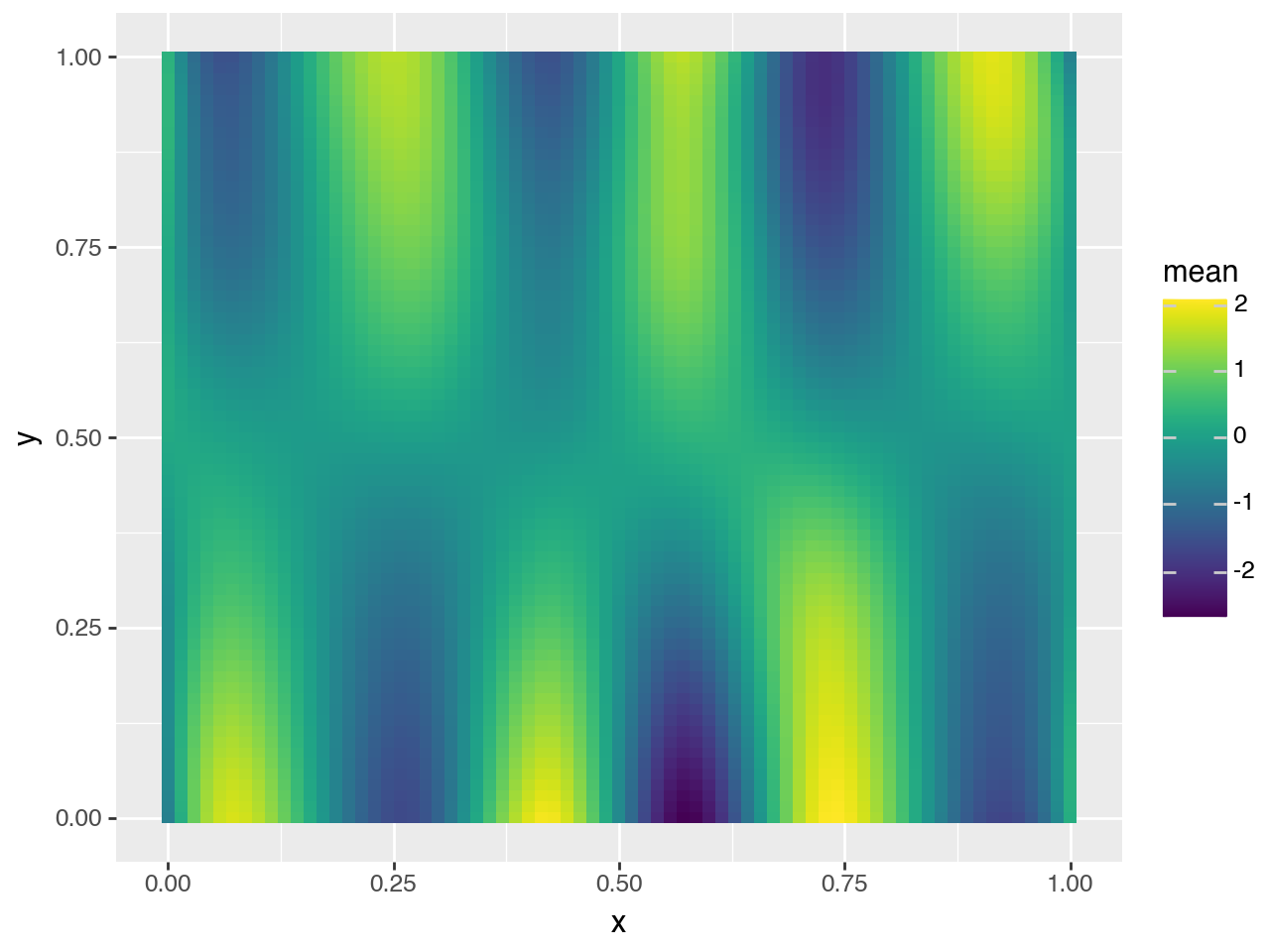
select = predictions_summary["variable"].isin(["tx(x,y)"])
(p9.ggplot(predictions_summary[select]) + p9.geom_tile(p9.aes("x", "y", fill="mean")))
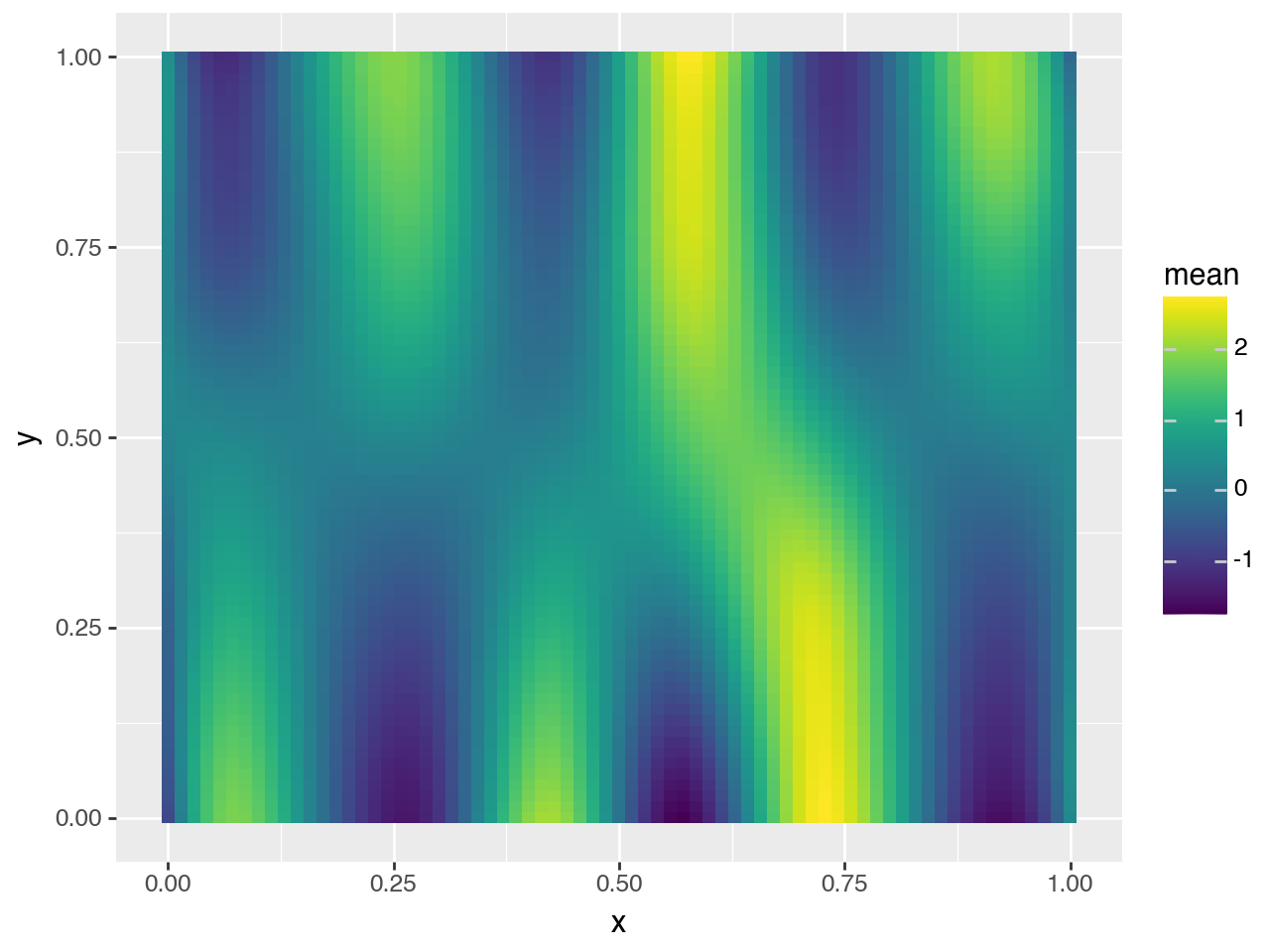
select = predictions_summary["variable"].isin(["$\\mu$"])
(p9.ggplot(predictions_summary[select]) + p9.geom_tile(p9.aes("x", "y", fill="mean")))
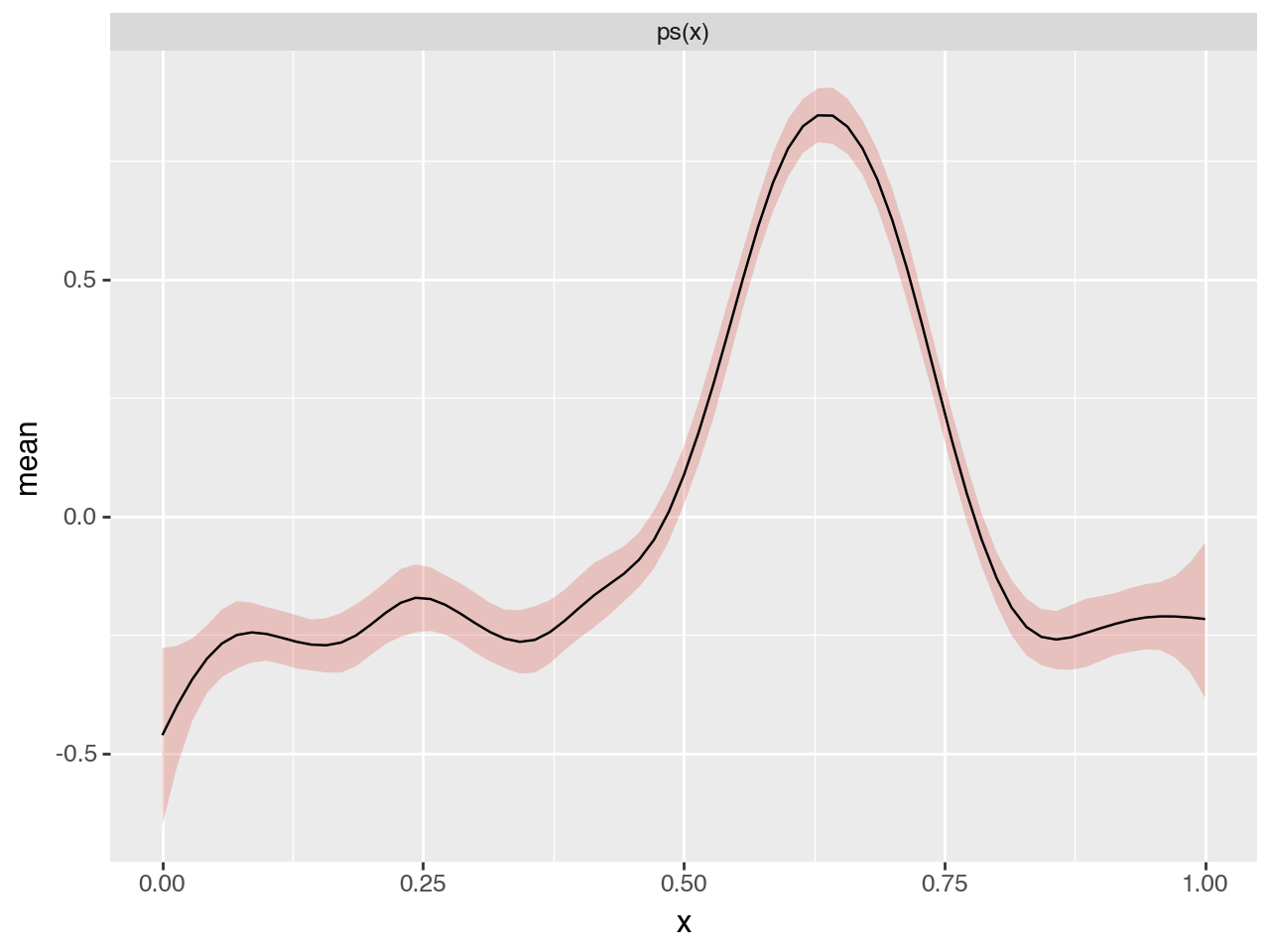
select = predictions_summary["variable"].isin(["ps(x)"])
(
    p9.ggplot(predictions_summary[select])
    + p9.geom_ribbon(
        p9.aes("x", ymin="q_0.05", ymax="q_0.95", fill="variable"), alpha=0.3
    )
    + p9.geom_line(p9.aes("x", "mean"))
    + p9.facet_wrap("~variable", scales="free_y", ncol=1)
    + p9.guides(fill="none")
)
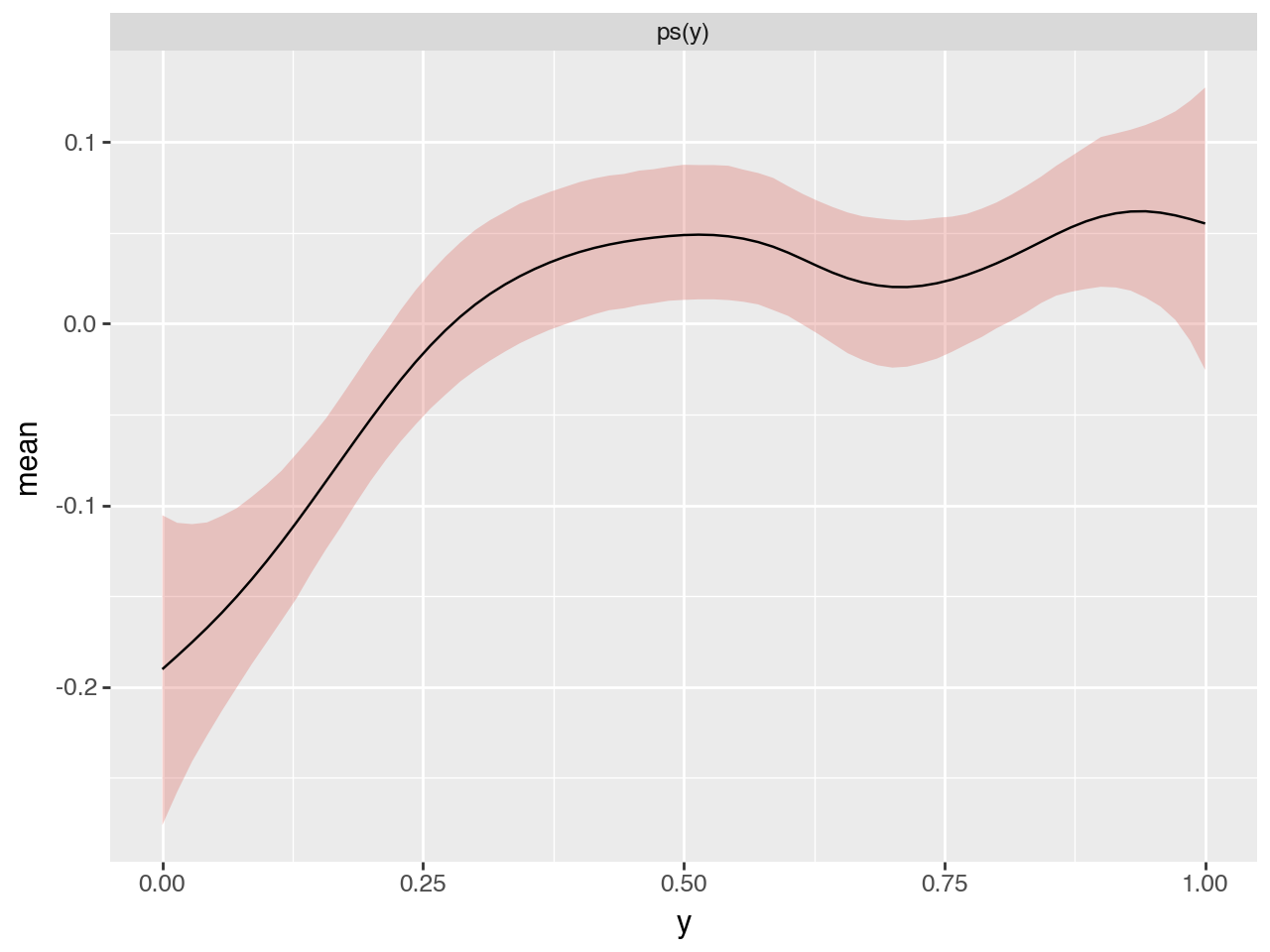
select = predictions_summary["variable"].isin(["ps(y)"])
(
    p9.ggplot(predictions_summary[select])
    + p9.geom_ribbon(
        p9.aes("y", ymin="q_0.05", ymax="q_0.95", fill="variable"), alpha=0.3
    )
    + p9.geom_line(p9.aes("y", "mean"))
    + p9.facet_wrap("~variable", scales="free_y", ncol=1)
    + p9.guides(fill="none")
)